

Anker SOLIX E10 vs EcoFlow TITAN 5000: Which Whole-Home Backup System Fits You?
Compartir
Whole-home backup systems are not interchangeable. The right choice depends on your essential loads, service-panel plan, installation path, solar input and the amount of stored energy you actually need.
The Anker SOLIX E10 and EcoFlow TITAN 5000 both combine high-output battery backup with expandable storage, but they take different approaches. This guide compares their verified core specifications and helps you decide which system deserves a closer look.
Quick comparison
| Feature | Anker SOLIX E10 | EcoFlow TITAN 5000 |
|---|---|---|
| Starting battery capacity | 6.144 kWh | About 5 kWh |
| Rated output | 7,680 W per power module | 7,200 W |
| System expansion | 6–90 kWh across supported configurations | 5–30 kWh |
| Voltage | 120/240 V split phase | 120/240 V system configurations |
| Solar input | Up to 9 kW per E10 power module; larger systems depend on configuration | Up to 4 kW |
| Automatic switchover | Up to 20 ms with the supported Power Dock configuration | Under 20 ms with the supported smart-panel configuration |
| Installation | Equipment only on LIVVOLT; installation is separate | Depends on the selected system and installation service |
Specifications above describe supported configurations, not every standalone box. Confirm the exact components in your order before comparing totals.
Where Anker SOLIX E10 stands out
E10 starts with a 6,144Wh battery module and a power module rated for 7,680W continuous output. The system supports 120/240V split-phase output and can expand through additional B6000 battery modules and, in larger approved systems, multiple power modules.
Its strongest differentiator is the expansion ceiling. Anker lists supported E10 systems from 6kWh to 90kWh. One power module supports up to five B6000 batteries, while a Power Dock can support up to three E10 units in approved configurations.
E10 also provides two photovoltaic inputs rated at up to 4,500W each. That high solar-input ceiling can matter for customers planning a substantial fixed-solar array rather than a small set of portable panels.
E10 may be the stronger fit when:
- You want to begin at 6kWh and retain a large expansion path.
- You require 120/240V split-phase capability.
- You plan a high-input solar configuration.
- You need weather-resistant equipment: the E10 power module and battery are listed as NEMA Type 4 / IP66.
- You are prepared to select a Smart Inlet Box or Power Dock configuration with professional guidance.
Where EcoFlow TITAN 5000 stands out
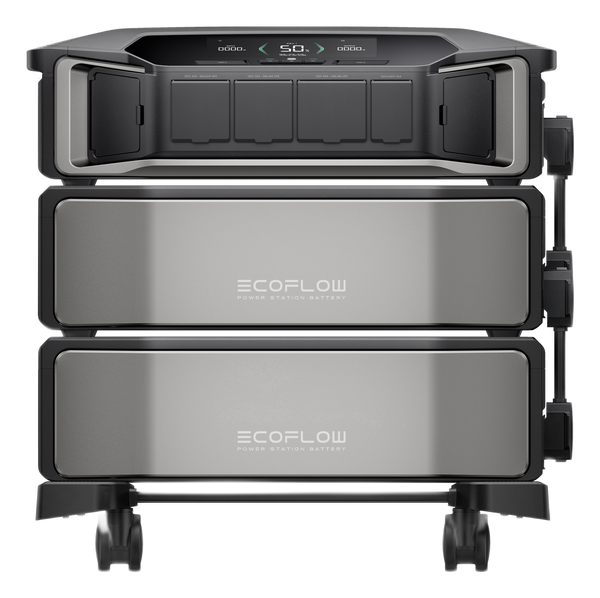
TITAN 5000 starts at roughly 5kWh, provides 7.2kW of rated output and supports expansion to 30kWh. It is positioned as a modular whole-home system with optional Smart Home Panel 10 integration.
The Smart Home Panel 10 supports app-based management of ten circuits. EcoFlow also describes storm preparation, time-of-use energy management and automatic switchover in under 20 milliseconds when the system is configured with the required equipment.
TITAN 5000 has a lower stated solar-input ceiling than one E10 power module—4kW versus E10’s two 4.5kW inputs—but 4kW may already be sufficient for many residential backup plans. More input is only valuable if the array, electrical design and local conditions can use it.
TITAN 5000 may be the stronger fit when:
- A 5–30kWh expansion range covers your expected needs.
- You want ten-circuit management through the Smart Home Panel 10.
- You prefer the EcoFlow app and energy-management ecosystem.
- You want a system designed around a 7.2kW output target.
- Your installation plan aligns with EcoFlow’s supported smart-panel configuration.
Power Dock, Smart Inlet Box or Smart Home Panel?
This is often more important than the battery brand.
An E10 Starter Kit contains one power module and one battery. A Smart Inlet Box provides a different connection path from a Power Dock. The Power Dock enables the larger whole-home and multi-unit configurations described on the E10 product page.
For TITAN 5000, the Smart Home Panel 10 provides circuit-level management and automatic backup functionality. Existing rooftop solar AC coupling also requires compatible equipment, including the supported smart panel and sensor configuration.
Do not assume that a standalone battery automatically provides whole-home backup. Panel equipment, overcurrent protection, permits, wiring and installation requirements depend on your home and local rules.
How much battery capacity do you need?
Start with a load worksheet instead of a product name:
- List essential appliances and their running watts.
- Record startup or locked-rotor demand for motors and air conditioners.
- Estimate how many hours each load must operate.
- Decide which loads may run at the same time.
- Add reserve for conversion losses, weather and future needs.
A 6kWh battery does not guarantee a full day of backup. Runtime changes dramatically depending on air conditioning, electric heating, water heating, cooking equipment and appliance duty cycles.
Safety, certification and installation
Both product families publish UL 9540-related safety information for supported systems. Certification applies to the tested configuration, so verify that the components and installation match the documentation.
LIVVOLT’s E10 listings are for equipment; installation is separate. Use the downloadable user guides, installer guides and certification documents on the product page, and work with qualified professionals where required.
Bottom line
Choose Anker SOLIX E10 when you value a larger expansion ceiling, higher solar-input potential and an outdoor-ready modular platform. Choose EcoFlow TITAN 5000 when a 5–30kWh system, 7.2kW output and ten-circuit Smart Home Panel ecosystem better match your home.
Neither system should be selected from capacity alone. Send LIVVOLT your essential-load list, air-conditioner specifications, service-panel information and desired runtime. We can help you compare the equipment configurations before you order.
Next step: Contact LIVVOLT for a system recommendation, or review the live Anker SOLIX E10 configurations and EcoFlow TITAN 5000 options.