


Cold-Weather Portable Power 2026: Charging, Runtime & LiFePO₄

Winter is where cheap power stations fail. Cold kills battery performance: capacity drops, charging slows, and the wrong chemistry can take permanent damage below freezing. If you camp, hunt, or just want backup during a snowstorm outage, you need to understand how cold-weather portable power actually behaves. Here's the straight answer, with real EcoFlow numbers.
1. Why cold hurts batteries
- Capacity dips. Below freezing, a battery's usable capacity can fall 10–20% because the chemical reaction slows.
- Charging is the real danger. Charging a frozen lithium cell can cause plating and permanent capacity loss. Good stations refuse to charge when too cold — which is a feature, not a bug.
- Discharging is safer than charging. Most stations will still power your gear in the cold even when they won't accept a charge.
2. LiFePO₄ vs old lithium-ion in the cold
Every station we sell uses LiFePO₄ (LFP) chemistry — the same type in EVs. Compared to the older NMC lithium-ion found in budget packs, LFP handles temperature swings far better and lasts 3,000+ cycles. Read our LiFePO₄ deep dive for the full comparison.
| Chemistry | Cold discharge | Cold charge | Cycle life |
|---|---|---|---|
| LiFePO₄ (EcoFlow) | Strong to ~-4°F | Throttled below 32°F | 3,000+ cycles |
| Old NMC lithium | Weakens early | Risk below 32°F | ~500 cycles |

3. How to charge in cold weather
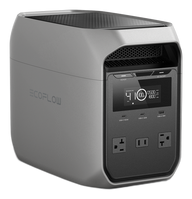
- Bring it inside. Store and charge the station at room temp. A DELTA Pro 3 charges to 80% in about an hour on wall power once it's warm.
- Pre-warm before solar. If you must solar-charge outside, let the bank sit in a warm vehicle first; the app warns you if cells are too cold to accept charge.
- Car charging helps. The 12V port pulls a trickle while driving — and the cabin keeps the battery in its comfort zone.
4. Squeeze runtime out of the cold
Two moves recover lost winter capacity:
- Keep the station near your body or inside. A DELTA 3 in a warm cabin easily out-runs the same unit left in a freezing truck bed.
- Size up. If you expect sub-freezing use, buy 20–30% more watt-hours than your summer math says. The sizing guide shows the math.

5. Solar in winter
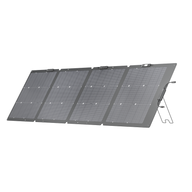
Panels don't care about cold — they actually perform slightly better in low temperatures. The catch is shorter days and low sun angle. A 400W panel still tops up a bank on a clear winter afternoon; just expect longer recharge times and keep snow off the glass.
6. FAQ — cold-weather power
Can I charge a power station in freezing weather?
Most LFP stations throttle or block charging below 32°F to protect the cells. Warm it indoors first, then charge. Discharging in the cold is usually fine.
Will my station die in a snowstorm outage?
No — keep it inside and it runs normally. A DELTA Pro 3 powers essentials for days; solar keeps it alive if the grid is down long.
Build a winter-proof kit
Pair a LiFePO₄ DELTA Pro 3 with a solar panel and you're ready for the coldest outage. New, dealer-backed, 5-year warranty.
Shop Winter Backup →Livvoltpower is an authorized EcoFlow dealer. Every unit ships with a 5-year warranty and US-based support. Battery performance in extreme cold varies by model and temperature.