


Job-Site Power 2026: Run Power Tools Anywhere with a Portable Station

Every contractor knows the line: "No outlet? No problem." For decades that meant a gas generator — loud, smelly, and the kind of thing neighbors call the city about. A 2026 portable power station does the same jobs silently, with no fumes, and recharges from the truck between sites. For job-site work, this is the most important tool upgrade in a decade.
This guide covers what power tools you can run, how to size the station, and the safety rules that keep your crew and your warranty intact.
1. Why a portable station beats a gas generator on a job site
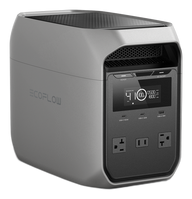
- Quiet. A DELTA Pro 3 runs at about 30 dB under load. A gas generator is 70–80 dB. On a residential job, that means you can run tools at 7am without complaints.
- No fuel. No gasoline to store, no fuel stabilizer, no oil changes. Pull it off the truck and go.
- Indoor-safe. Working in a basement, garage, or finished interior? A battery station is safe. A gas generator isn't.
- Lower total cost. A 3–4kWh station pays for itself in 1–2 years if you're burning gas for tools daily.
2. Power draw: what tools can a station actually run?
| Tool | Wattage | Recommended station |
|---|---|---|
| Drill / driver | 300–800W | DELTA 3 |
| Circular saw | 1,200–1,800W | DELTA 3 Max |
| Miter saw | 1,500–2,400W | DELTA 3 Max |
| Table saw | 1,800–2,400W | DELTA Pro 3 |
| Air compressor (1–6 gal) | 1,500–2,000W | DELTA Pro 3 |
| Concrete vibrator | 800–1,500W | DELTA 3 Max |
| HEPA vac / dust extractor | 1,000–1,400W | DELTA 3 Max |
The number that matters is the tool's surge watts (the spike when the motor starts). A 1,500W miter saw can pull 4,000W at the instant of startup. Pick a station with surge headroom — 2× the continuous rating is a safe rule.

3. Best models for the trades
- Trim carpenter / remodeler: the DELTA 3 Max (2kWh, 3,400W output) covers miter saws and most compressors in a single carry-friendly unit.
- General contractor / framer: the DELTA Pro 3 (4kWh, 4,000W continuous, 8,000W surge) runs table saws, big compressors, and a 120V/240V welder.
- Service tech / HVAC: a DELTA 3 (1kWh, 1,800W) covers drill, vacuum, and a small inverter welder for one or two tasks.
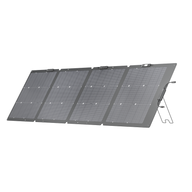
- Multi-day remote job: add a 220W solar panel on the truck roof or a tail-gate deploy panel. The station recharges during the day and runs tools through the night.
4. Recharging the station between job sites
The most underrated feature: a portable station recharges from any 12V car outlet in 3–4 hours, or from a 220W panel in 2–3 hours of sun. Drive between sites with the truck's 12V plugged in, and the station arrives at the next job topped up. No more "battery is dead" mid-afternoon. For overnight charging, a 120V wall outlet refills the DELTA 3 in 90 minutes, the DELTA 3 Max in 2 hours, the DELTA Pro 3 in 2.5 hours.
5. Solar for multi-day jobs
For a 3–5 day job with no power on site, two 220W panels and a DELTA Pro 3 give you a self-sustaining loop. The station runs tools during the day, the panels recharge it during lunch, and you can run intermittent tools (drill, saw, vacuum) indefinitely. The real win: no generator to fuel, no extension cords to run, no HOA complaints.
6. Safety and warranty rules
- Surge headroom: never size a station to the continuous watts; always size to 1.5–2× the surge.
- Use a GFCI-protected outlet. All EcoFlow 120V outlets are GFCI. For 240V on the DELTA Pro 3, use a listed 240V receptacle.
- Keep the station cool. A station in a 100°F truck bed will throttle. Park it in the shade or pull it onto the floor.
- Update firmware. EcoFlow releases BMS updates that improve surge handling. Update via the app before big jobs.

7. FAQ — job-site power
How many hours of tool runtime per charge?
A 2kWh station running a 1,500W miter saw gives you ~1 hour of continuous cutting. Typical trim work uses 10–20 minutes of saw time per hour, so plan for a full day of trimming on a single DELTA 3 Max charge.
Can a portable station replace a gas generator on a construction site?
For residential and small commercial work, yes. For framing a whole house with a 15-amp table saw all day, no — you still want a gas generator or site power. Most contractors end up using both.
What's the difference between X-Boost and a real high-wattage station?
X-Boost lets a DELTA 3 run tools up to 2,400W by lowering voltage slightly. It's fine for short bursts. For heavy continuous loads, step up to the DELTA 3 Max or DELTA Pro 3 with true 3,400–4,000W output.
Quiet the job site
Drop the gas generator, keep the tools. Every Livvoltpower station is a new, dealer-backed unit with a 5-year warranty and US-based support — call us when you need to spec a crew fleet.
Shop Job-Site Stations →Livvoltpower is an authorized EcoFlow dealer. Every station ships with a 5-year warranty and US-based support. Tool wattages reflect manufacturer data; verify against your tool's nameplate.