


Sump Pump & Well Pump Backup 2026: Beat Flooding During Outages

Most people don't think about their sump pump until the lights go out. That's the worst time to discover a gas generator in the garage that needs fuel, extension cords, and a manual start. A portable power station with a transfer switch is the modern sump-pump backup: silent, automatic, and ready to run the moment the grid drops. The same setup also keeps a well pump alive when the rural power blinks out.
This guide covers how to size a station for a pump, why surge handling matters, and the wiring setup that turns a portable battery into a real pump UPS.
1. The flood risk during an outage
Storms cause power outages. Power outages cause sump pumps to fail. Sump pump failures cause flooded basements. The average basement flood costs $10,000–$50,000 in damage — far more than a $2,000 portable station. The math is simple: an hour of pump coverage during a storm pays for the station in a single avoided incident.
Well pumps fail in rural outages too. If your house runs on a well, a 4-hour outage means no water, no toilet flushing, no showers. A station that can run the well pump during an outage isn't a luxury — it's infrastructure.
2. How much power does a pump actually need?
| Pump type | Wattage | Surge | Typical runtime |
|---|---|---|---|
| Sump pump (1/3 HP) | 800W | 1,500W | 5–15 min/hour |
| Sump pump (1/2 HP) | 1,050W | 2,000W | 5–15 min/hour |
| Sump pump (3/4 HP) | 1,500W | 3,000W | 5–15 min/hour |
| Well pump (1/2 HP) | 1,000W | 2,500W | 2–5 min/hour |
| Well pump (1 HP) | 1,700W | 4,000W | 2–5 min/hour |
| Well pump (1.5 HP) | 2,500W | 6,000W | 2–5 min/hour |
Sump pumps run intermittently — they get a call from the float switch, run until the water drops below the float, and stop. A typical sump pump runs 5–15 minutes per hour during heavy rain. That duty cycle is the key to sizing: a 1/2 HP pump drawing 1,050W with a 10-minute-per-hour duty cycle consumes only 175Wh per hour. A 4kWh station covers that for ~23 hours.

3. The best models for pump backup
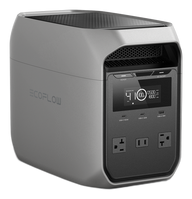
- 1/3 HP sump pump: a DELTA 3 (1kWh, 1,800W output) covers a small sump pump for 10+ hours of intermittent runtime.
- 1/2 HP sump pump (most common): a DELTA 3 Max (2kWh, 3,400W output) covers a typical residential sump pump for 15–20 hours of intermittent runtime.
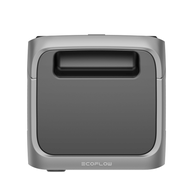
- 3/4 HP sump + 1 HP well pump: a DELTA Pro 3 (4kWh, 4,000W output) handles both pumps for a full day and supports surge up to 8,000W.
- Whole-home backup with both pumps and the fridge: a DELTA Pro 3 plus a Smart Home Panel 2 — automatic transfer during outage, automatic reversion when grid returns.
4. The wiring: transfer switch or smart home panel?
For a real pump backup, you can't just plug the pump into the station — the pump is wired to a wall outlet. The cleanest solution is a transfer switch (manual or automatic) that disconnects the pump circuit from the grid and connects it to the station when the grid drops. The EcoFlow Smart Home Panel 2 does this automatically with the DELTA Pro 3 in 30 milliseconds — fast enough that the pump doesn't lose prime.
For a quick-and-dirty solution, a licensed electrician can wire a single-circuit interlock that lets you flip the sump pump breaker from "grid" to "station" in under a minute. This is the most common DIY-friendly approach.
5. Why surge handling matters for pumps
Motor-driven loads (pumps, saws, compressors) draw 2–3× their rated wattage on the surge that happens when the motor starts. A 1,500W well pump can pull 4,000W at startup. If the station can't handle the surge, the BMS shuts the station off to protect itself — and the pump never starts. Pick a station with surge headroom at 2–3× the continuous rating. The DELTA Pro 3's 8,000W surge handles even 1.5 HP well pumps; the DELTA 3 Max's 6,800W surge handles most residential pumps.
6. Solar for multi-day outages
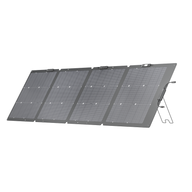
A 220W or 400W solar panel on the roof or in the yard keeps the station topped up during a multi-day outage. A 220W panel produces 800–1,200Wh on a sunny day — enough to run a sump pump for 6+ hours of intermittent duty and still charge phones and run lights. A 400W panel triples that. For a rural home on a well, solar + station + pump is resilience on par with a whole-home generator — at a fraction of the cost.
7. Maintenance and testing
A sump-pump backup system is only useful if it works when you need it. Test it monthly: unplug the station from the wall, pour a bucket of water into the sump pit, and verify the pump runs from the station. Test the transfer switch twice a year. Top off the station's charge monthly. See our care guide for the full storage rules.

8. FAQ — sump pump & well pump backup
How long will a station run a sump pump?
A 2kWh station running a 1,050W sump pump (10-min/hr duty cycle) covers 15–20 hours of intermittent runtime. A 4kWh station doubles that.
Can a portable station run a well pump?
Yes — the DELTA Pro 3 handles up to 8,000W surge, which covers most 1–1.5 HP well pumps. For larger pumps, step up to the DELTA Pro 3 with parallel expansion.
Do I need a transfer switch?
For automatic backup, yes. A manual interlock works for short outages. For whole-home protection, the EcoFlow Smart Home Panel 2 is the cleanest answer.
Will the station run a sump pump all night?
A 1kWh station covers 8–10 hours of typical sump pump duty. A 2kWh station covers 15–20 hours. A 4kWh station covers 1.5–2 days. Add solar for indefinite coverage.
Don't let the basement flood
A DELTA 3 Max or DELTA Pro 3 with a transfer switch is the cheapest basement insurance you can buy. Every Livvoltpower station ships new, dealer-backed, with a 5-year warranty and US-based support.
Shop Sump Pump Backup →Livvoltpower is an authorized EcoFlow dealer. Every station ships with a 5-year warranty and US-based support. Pump wattages reflect manufacturer data; verify against your specific pump's nameplate. Electrical work should be performed by a licensed electrician.